
Latitude for Memories: The Work of Luisa Duarte
REVIEW:BY SUSANA BENKO, CURATOR AND RESEARCHER, MEMBER OF THE INTERNATIONAL ASSOCIATION OF ART CRITICS, AND EDITOR, ART NEXUS.
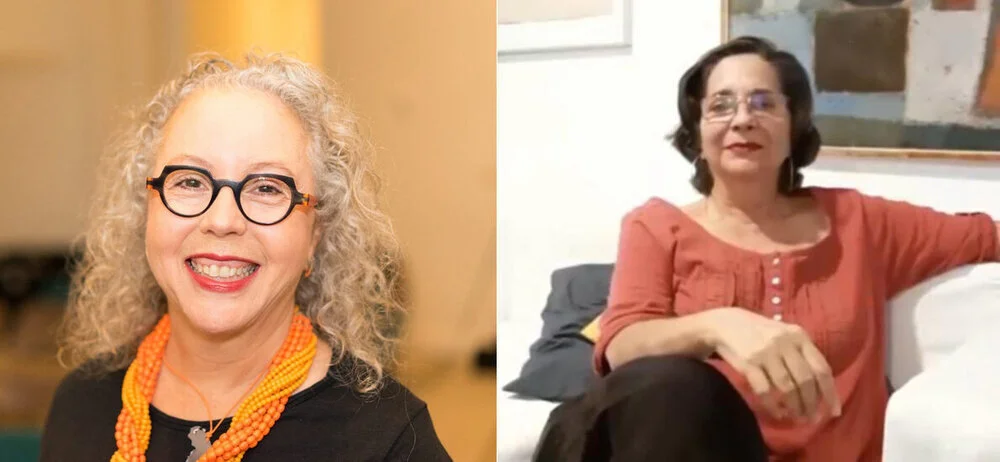
Luisa Duarte and Susana Benko.
Luisa Duarte is a Visual Artist and Architect. She was born in Caracas, lived and studied in Maracaibo, and has made Houston, Texas, her home for some time now. This geographical and experiential trajectory is so much more than a biographical observation. It is the guiding axis for a journey that will allow us to get to know the artist and her work.
Luisa Duarte’s visual language is abstract art. In her work, the artist approaches abstraction in two different modalities: in a lyrical and informal expression, and in beautiful geometric compositions. However, it should be noted that the transition from one modality to another cannot be explained chronologically. It is the outcome of formal and emotional situations that can occur simultaneously. It is also somewhat subject to the media and techniques that she is using, whether she is using paint, or printing on paper, and it also hinges on the conceptual intention behind each of her series.
This openness and versatility in her work allows her to expand the field of her research and intentionally avoid being pigeonholed into one form of expression. It also permits the unpredictable and the ‘reasonably calculated’ to arise simultaneously in her creative process. This synergy becomes evident in her images and compositions, as well as in her choice and use of materials. In this sense, the artist may cut a large-format work into small strips and then incorporate them into a geometric collage; other works incorporate various approaches.
For example, in The Sentinels, the artist has created monotypes with geometric forms; however, within each form subtle textures reveal manual intervention with ink on paper. The combination allows the artist to express an idea or remembrance of a territory, a theme that is present in all of her work. This spatial demarcation is accentuated when she uses sewing thread as a tool to ‘draw,’ attaching thread to paper with pins, and continuing the geometric drawing that is proposed in the print. She has developed a similar approach in her large-format art installations, where the walls are incorporated into the work as a support.
Another subject of inquiry in Luisa Duarte's work is color. In a series of paintings titled Blues, created in 2011, the artist had begun creating chromatic “climates” using a range of shades of blue. However, it wasn’t until 2014, when she began using digital technology as a tool, a practice that greatly impacted her work and pushed it forward. This medium would become a source of discovery, and revealed new insights in her work, enabling her to create forms with multiple approaches and perspectives. Her use of color – and the possibilities associated with variations of shade, tone and transparency– in combination with form, is enriched through the process of layering multiple digital printing passes on a single sheet of paper. In this way, the digital printer has become an essential tool in some of her work. Through her dexterity with this medium, the artist is able to reconstruct spaces and geographies that inhabit her memory through the study of form and color.
Not only do the fields of color evoke the drought-ridden territories of Maracaibo; the superimposed planes of color, in a range of facets, allude to intimate spaces, such as a former home that is no longer hers. This theme would become central to a recent project that focused on the deconstruction of an image, or a visual memory, rendered in full color, of the last house she inhabited in Maracaibo. Impressions of this recent series have been gathered in a special artist book, and in mock-ups of various formats, that may be presented in the future as an installation.
In reviewing this artist’s trajectory, one may wonder how is it possible for an abstract work to reference such dense and fragile motifs -- such as those intimate spaces that inhabit memory –at once. Abstract art assumes the absence of the representation of content beyond those set forth in formal visual criteria. The answer can be found precisely in the expressive elements used so deftly by the artist: form, light, transparency, and color. It is through these elements that the artist evokes spaces that are revealed to her through memory, irrespective of the passing of time.